

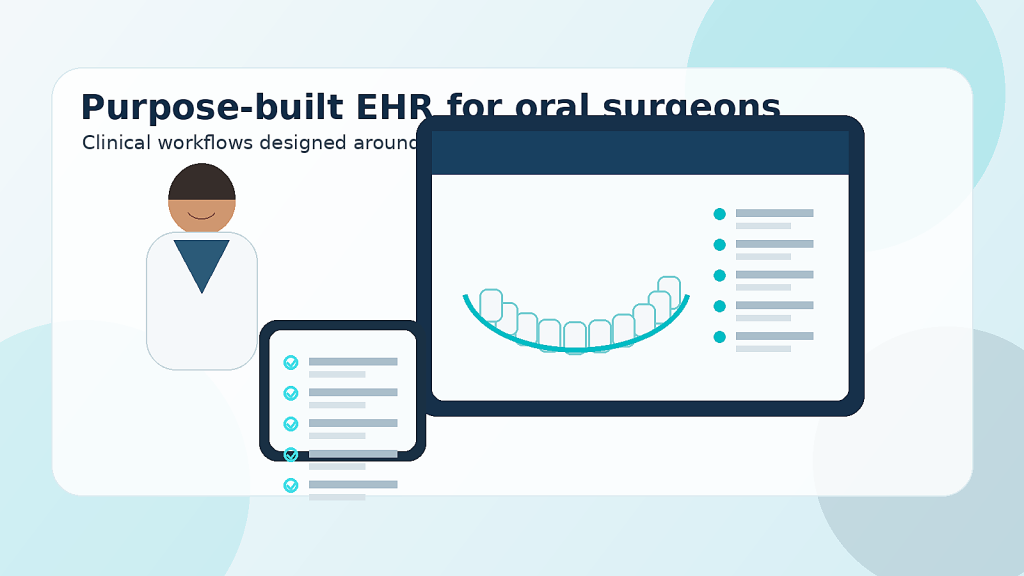
The Challenge of Running a Modern Oral Surgery Practice
Oral and maxillofacial surgery is one of the most technically demanding specialties in dentistry. Between complex surgical procedures, anesthesia administration, detailed clinical documentation, and the coordination of pre- and post-operative care, oral surgeons face documentation and workflow burdens that general-purpose EHR systems simply were not designed to handle. For years, many OMS practices have cobbled together solutions — a general dental EHR here, a spreadsheet there, paper anesthesia records tucked into patient charts. The result is inefficiency, compliance risk, and a clinical experience that does not match the sophistication of the care being delivered. That is changing. Purpose-built EHR software for oral surgery practices is now available, and clinicians across the country are making the switch. Here is why — and what to look for when evaluating your options.
What Makes EHR Software for OMS Practices Different
Not all electronic health record systems are created equal. General practice EHRs are designed around the workflows of a family medicine clinic or a general dental office. They track appointments, record diagnoses, and generate billing codes. But oral and maxillofacial surgery demands far more. Purpose-built practice management software for oral surgeons addresses the specific clinical realities of OMS:
- Procedure-specific documentation templates — From wisdom tooth extractions to orthognathic surgery to implant placements, each procedure type requires its own structured note format. Generic EHRs force workarounds; OMS-specific software provides templates out of the box.
- Integrated anesthesia records — OMS practices administer anesthesia at a higher rate than almost any other dental specialty. Recording induction medications, monitoring intervals, vital signs, and emergence notes must be seamless and compliant. A purpose-built system handles anesthesia records as a first-class feature, not an afterthought.
- Surgeon’s task management — The day of a busy oral surgeon involves dozens of micro-decisions: confirming lab work is in, reviewing pre-op imaging, checking consent status, coordinating with staff on room turnover. A well-designed OMS EHR surfaces these tasks in a structured daily workflow, reducing the cognitive load on the surgeon.
- Informed consent workflows — Informed consent documentation is a legal and ethical cornerstone of surgical practice. Purpose-built OMS software generates, tracks, and stores consent forms linked directly to the patient’s surgical encounter.
- Image viewing integrated into the clinical record — OMS clinicians rely on panoramic X-rays, CBCT scans, and clinical photographs. An OMS EHR that integrates imaging directly into the patient chart eliminates the need to switch between applications during surgical planning and execution.
The Case for EMR Software Designed Around Your Workflow
When evaluating EMR software for oral surgery and maxillofacial practices, the most important question is not “Does this system check all the feature boxes?” but rather “Does this system reflect how my team actually works?” Oral surgeons and their clinical teams develop highly efficient workflows over years of practice. A new software system should enhance those workflows — not force a redesign around the software’s limitations. The best EHR for OMS practices will feel intuitive to surgeons and clinical staff from day one. It will reduce the number of clicks required to complete a surgical note. It will surface the right information at the right moment — pre-op vitals before induction, implant specs before placement, follow-up instructions before discharge.
Reducing Documentation Burden for Clinicians
One of the most consistent complaints among oral surgeons about generic EHR systems is documentation time. Surgeons and clinical staff often spend more time documenting care than they spend delivering it. Studies across surgical specialties consistently show that documentation burden contributes directly to clinician burnout. Purpose-built EHR software for oral surgery practices addresses this in several ways:
- Smart defaults and auto-populated fields based on procedure type
- Structured note templates that guide documentation without constraining clinical judgment
- Rapid access to previous encounter data for comparison and continuity
- Integrated prescription and post-operative instruction generation
The result is a clinical record that is complete, compliant, and created in a fraction of the time it takes with a general-purpose system.
Anesthesia Records: Where General EHRs Fall Short
For any OMS practice that provides IV sedation or general anesthesia, the anesthesia record is not optional — it is a core clinical and legal document. State dental boards and accreditation bodies have strict requirements about what anesthesia records must contain, how they must be maintained, and how long they must be kept. General EHRs rarely include a purpose-built anesthesia module. Oral surgeons using these systems often maintain paper anesthesia records or use a separate software tool — creating fragmented records, version control risks, and inefficiency at a moment in patient care when focus should be entirely on the patient. A well-designed EMR software for oral surgery and maxillofacial practices integrates anesthesia documentation directly into the surgical encounter record. Pre-op assessment, medication administration, intra-operative monitoring, and post-op recovery notes are all captured in one place, tied to the patient and the procedure.
Practice Management Software for Oral Surgeons: The Bigger Picture
Clinical documentation is only one part of what practice management software for oral surgeons needs to do. A high-performing OMS practice also needs:
- Scheduling efficiency — Surgical block scheduling, room and equipment assignment, and staff coordination all require more sophisticated scheduling tools than a standard appointment calendar.
- Insurance and billing integration — OMS billing involves both medical and dental insurance, pre-authorizations for complex procedures, and a billing code set that spans CDT and ICD. Practice management software needs to handle this complexity without requiring manual workarounds.
- Patient experience from referral to follow-up — Most OMS patients arrive via referral from a general dentist or another specialist. Practice management software that supports the full referral workflow — intake, communication with the referring provider, and post-operative summary reports — builds the relationships that drive practice growth.
- Reporting and analytics — Practice owners and administrators need insight into production, collections, procedure mix, and capacity utilization. Built-in reporting that reflects OMS-specific metrics enables better decision-making.
Evaluating EHR Software for Your OMS Practice: Key Questions
When you are ready to evaluate EHR software for OMS practices, approach the process with a structured set of criteria. Here are the questions that matter most:
- Was this system built for oral surgery, or adapted from a general platform? The answer shapes everything — template quality, workflow logic, and the long-term development roadmap.
- How does the system handle anesthesia records? Ask to see the anesthesia documentation module in action. It should be structured, time-stamped, and tightly integrated with the surgical record.
- What does the surgeon’s daily workflow look like? Request a walkthrough of a typical surgical day, from opening the schedule in the morning to closing the last surgical note at the end of the day.
- How is implementation and training handled? Transitioning an OMS practice to new software is a significant undertaking. Ask about data migration, training timelines, and ongoing support.
- What is the vendor’s track record with practices like yours? Speak with references at OMS practices of similar size and surgical volume. Ask specifically about documentation efficiency and clinical staff adoption.
MaxilloSoft: Built by Oral Surgeons, for Oral Surgeons
MaxilloSoft was developed from the ground up for oral and maxillofacial surgery practices. Every feature — from the anesthesia record module to the surgeon’s daily tasklist to the integrated image viewer — was designed with the specific clinical realities of OMS in mind. Clinicians who switch to MaxilloSoft consistently report faster documentation, better-organized patient records, and a system that actually reflects the way a surgical practice operates — not one that forces them to adapt their clinical workflow to software limitations. If you are evaluating EHR software for your oral surgery practice, or if you are simply ready to retire the workarounds that have accumulated in your current system, the right place to start is a conversation with the MaxilloSoft clinical team. Ready to see what purpose-built OMS EHR software looks like in practice? Explore MaxilloSoft for Clinicians and request a personalized demo tailored to your practice’s workflow. Related MaxilloSoft resources: pricing details.
