

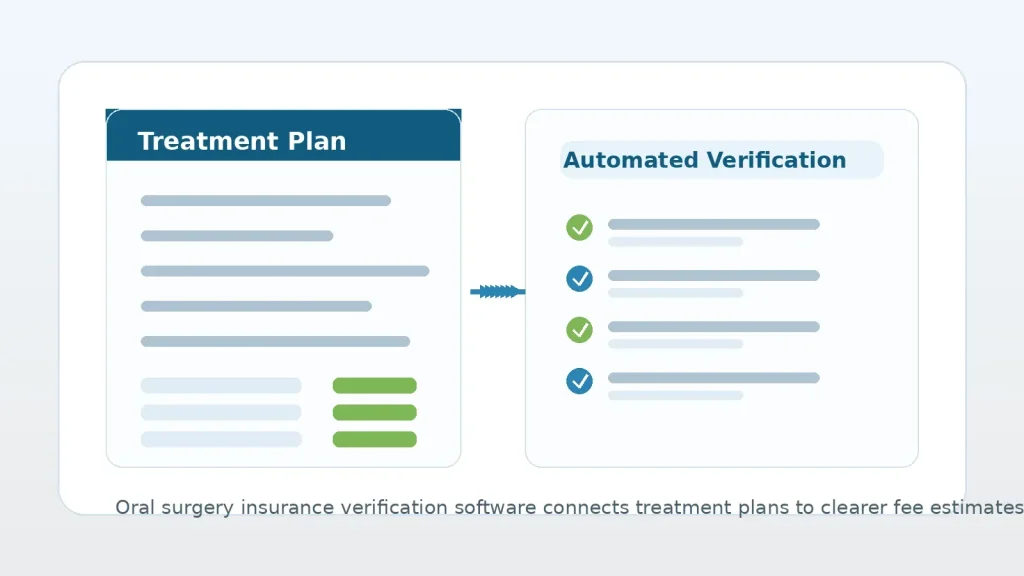
Oral surgery insurance verification software matters most when the schedule is full, treatment plans are complex, and patients need a clear cost estimate before they commit. Manual verification can still work for a low-volume office, but in a busy OMS practice it creates delays at exactly the wrong time: before treatment acceptance, before collections, and before the billing team can see whether a case is financially clean.
Ready to reduce insurance friction for your administrative team? Explore MaxilloSoft for practice administrators.
For oral and maxillofacial surgery groups, the issue is not just whether benefits are checked. The issue is whether the verification process is tied tightly enough to the surgeon’s treatment plan, the practice fee schedule, and the documents patients and payers actually see. When those pieces are disconnected, revenue leakage becomes easy to miss.
Why manual OMS insurance verification leaks revenue
Insurance verification in oral surgery is more complicated than a basic eligibility check. A single case may involve medical and dental coverage, and knowing how medical billing for oral surgery differs from standard dental claims, multiple procedure codes, remaining deductibles, annual maximums, coordination rules, preauthorization requirements, and plan-specific exclusions. When that work depends on phone calls, portals, spreadsheets, and repeated re-entry, the practice absorbs risk at every handoff.
Common manual steps include:
- Calling insurance representatives and waiting on hold for plan details.
- Logging into multiple payer portals to confirm eligibility and benefits.
- Copying coverage notes into the practice management system.
- Rechecking deductibles, maximums, and estimated patient portions.
- Building a treatment estimate manually after the surgeon finalizes the plan.
- Explaining the estimate to the patient without a consistently formatted document.
Each step may seem reasonable on its own. Together, they create a workflow where a missed code, stale benefit detail, or incomplete note can become a claim adjustment, a patient billing dispute, or an avoidable accounts receivable delay.
The real cost is not only staff time
Phone holds and portal work are visible costs. The less visible costs often show up later in the revenue cycle. If the estimate was built from incomplete benefits, the patient may underpay upfront. If the treatment plan changed but the estimate did not, the claim may not match what the patient expected. If the documentation is hard to read, the insurance company or patient may push back because the fee explanation feels unclear.
For practice administrators and billing coordinators, that means the verification problem becomes an A/R problem. Staff spend time reopening cases, answering balance questions, correcting notes, sending statements, and explaining why the final responsibility differs from the original estimate. Even when the team eventually collects, the practice has carried unnecessary friction.
How automated verification should connect to the surgeon’s treatment plan
The strongest automation is not a standalone eligibility lookup. It is verification connected to the clinical plan. In an OMS workflow, the surgeon’s treatment plan is the source of truth for what the patient is expected to receive. When the plan is submitted, the administrative system should be able to use that information to support a fast, precise fee estimate.
That connection changes the sequence of work. Instead of asking the billing team to interpret the plan, gather benefits, calculate patient responsibility, and rebuild the estimate by hand, the system can help turn the treatment plan into an actionable financial document. The result is a more consistent estimate while the case is still fresh, not hours or days later.
MaxilloSoft was built specifically for oral surgery workflows, not adapted from a general dental template. Its broader practice system connects clinical documentation, administrative visibility, patient flow, and insurance-related workflows so OMS teams can reduce duplicate entry and keep the practice moving from consult to treatment acceptance.
What makes a fee estimate hyper-accurate?
A useful estimate needs more than a total price. It needs the right procedure details, fee schedule management, the right coverage assumptions, and a clean explanation of how the patient portion was calculated. In oral surgery, accuracy depends on combining clinical and administrative data in one workflow.
High-quality automated fee estimation should account for:
- The surgeon’s selected procedures and treatment plan details.
- The practice fee schedule and expected billing structure.
- Dental and medical benefit information where applicable.
- Known deductible, maximum, copay, and coinsurance details.
- Documentation that supports the recommended treatment and estimate.
Automation does not remove the need for experienced billing judgment. It gives that judgment a cleaner foundation. Billing coordinators can focus on exceptions, payer nuance, and patient communication instead of repetitive data entry.
Why treatment plan presentation affects collections
Patients often hear the clinical recommendation and the financial estimate in the same decision window. If the treatment plan document looks rushed, confusing, or incomplete, the financial conversation becomes harder. A beautifully formatted treatment plan gives the patient a clear record of what is recommended, why it matters, and what they are expected to pay.
Clear documentation also reduces avoidable back-and-forth with insurance companies. When the plan, procedure details, and supporting information are organized consistently, the billing team has a stronger reference point for benefit questions, preauthorization discussions, and claim follow-up.
This is where oral surgery insurance verification software should support the patient experience, not just the back office. The patient should leave with a polished document that feels credible. The administrative team should have a matching internal record that is easier to defend, update, and collect against.
If your team is comparing systems, review MaxilloSoft’s consultation-based pricing approach to understand what is included for your practice.
How automation improves upfront collections
Upfront collections, supported by payment software for oral surgery, depend on confidence. Staff need confidence that the estimate is current. Patients need confidence that the amount is not arbitrary. Administrators need confidence that the collection policy is being applied consistently across providers, locations, and coordinators.
Automated fee estimation supports that confidence by making the estimate available sooner in the workflow. When the financial conversation happens close to the consult, the patient can ask questions while the plan is clear. The team can collect the expected portion before treatment instead of waiting for statements after the claim adjudicates.
That does not mean every estimate will be perfect. Insurance is still insurance. Plans change, payers process claims differently, and exceptions happen. But a connected workflow reduces preventable variation, which is where many disputes begin.
Administrative ROI: fewer disputes, cleaner A/R, faster cash flow
For an OMS administrator, the return on automation is measured in cleaner operations. The practice does not only save minutes on each verification. It reduces the downstream work caused by poor estimates and fragmented documentation.
The operational gains often include:
- Fewer manual verification touches per case.
- Less duplicate entry between clinical and administrative systems.
- More consistent patient estimates across the practice.
- Fewer billing disputes when the billing claims workflow is coordinated with verification caused by unclear treatment plan documents.
- Reduced pressure on A/R follow-up because more is collected upfront.
- Faster visibility into where cases are delayed or financially incomplete.
MaxilloSoft customers have reported meaningful efficiency gains across the practice, including saving 60 to 90 minutes per surgeon per day and measurable production improvements in documented case studies. Those outcomes are possible because the system focuses on the entire OMS workflow, including the administrative bottlenecks that slow down cash flow.
What should administrators look for in verification software?
When evaluating oral surgery insurance verification software, administrators should look beyond a feature checklist. The key question is whether the system fits how oral surgery actually works.
| Evaluation area | Why it matters for OMS practices |
|---|---|
| Treatment plan connection | Estimates should be based on the surgeon’s actual plan, not a separate manual worksheet. |
| Specialty-specific workflow | OMS practices need support for surgical, anesthesia, medical, and dental billing complexity. |
| Consistent patient documents | Clear treatment plan presentation improves patient understanding and reduces pushback. |
| Administrative visibility | Leaders need to see bottlenecks before they become A/R problems. |
| Reduced duplicate entry | Every repeated field increases the chance of error and slows the team down. |
Because MaxilloSoft is built by oral surgeons for oral surgeons, its value is not limited to one billing task. It supports a connected operating model where the clinical plan, administrative workflow, and patient communication work together.
Where should an OMS practice start?
The best starting point is to map the current verification workflow from consult to collection. Identify where staff re-enter information, where estimates wait for follow-up, where patients receive unclear documents, and where billing disputes tend to begin. Those are the points where automation can create the fastest operational lift.
Then evaluate whether your current software helps or simply stores the problem. A modern OMS practice management platform should reduce repeated work, support accurate fee estimates, and give administrators better visibility into the financial health of each case.
To see how a surgeon-built system supports administrative efficiency, start with MaxilloSoft’s administrator pathway or visit the pricing page to request a practice-specific conversation.
Frequently asked questions
What is oral surgery insurance verification software?
Oral surgery insurance verification software helps OMS practices confirm coverage details, connect those details to treatment plans, and create clearer fee estimates before treatment. The goal is to reduce manual benefit checks, improve upfront collections, and limit billing disputes.
Why is insurance verification harder for oral surgery practices?
Oral surgery cases often involve surgical procedures, anesthesia, medical and dental benefits, preauthorization requirements, deductibles, and plan-specific rules. That complexity makes manual verification more error-prone than a basic eligibility check.
Can automated fee estimates eliminate all billing adjustments?
No software can control every payer decision or plan change. Automated fee estimation helps reduce preventable errors by using cleaner treatment plan data, consistent workflows, and clearer documentation.
How does better verification improve patient experience?
Patients are more comfortable moving forward when the treatment plan and expected financial responsibility are explained clearly. A polished estimate reduces confusion, supports upfront collections, and gives the team a better foundation for financial conversations.
A cleaner path from treatment plan to collection
Manual verification puts too much pressure on billing coordinators to hold the revenue cycle together with phone calls, portal notes, and memory. Oral surgery insurance verification software gives administrators a more reliable path: connect the surgeon’s plan to an accurate estimate, present the patient with a clear document, and reduce the rework that slows collections.
For OMS practices trying to protect cash flow without adding more administrative burden, that connection is where the revenue leakage starts to close.
